
Design Is in the Details: What Architecture and Swiss Watchmaking Share in Philosophy

The architect who dismisses the detail drawing as secondary to the concept has misunderstood what architecture is. The concept without the detail is a rendering. The detail, executed correctly, across every element of a building — the reveal at a wall junction, the drainage profile on a terrace, the way a curtain wall joint behaves under thermal movement — is where architecture actually exists. Not on the concept board. In the built work.
Swiss watchmaking understood this before the word "design" was broadly applied to manufactured objects.
The Reveal and the Chamfer
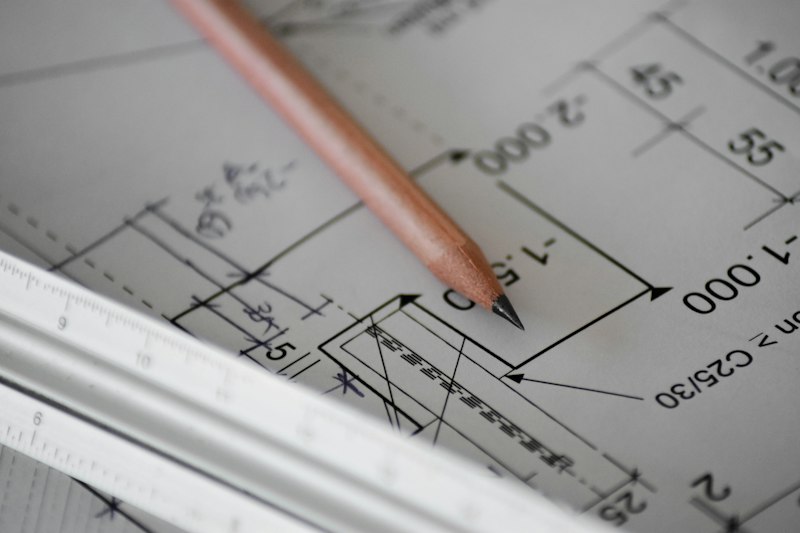
In architectural drawing, a reveal — the small recessed plane at a material transition — exists to manage the inevitable imprecision of construction. No two materials meet perfectly. The reveal acknowledges the joint while controlling how light falls across it, transforming a potential defect into an intentional element.
Swiss watchmakers developed an equivalent: the anglage, or hand-beveling of movement bridges. Every bridge and plate in a finished movement has its edges beveled to approximately 45 degrees, then polished to a mirror finish against a flat finish on the main surface. The contrast between polished bevel and brushed plane is the watch equivalent of the architectural reveal — a detail that acknowledges the edge while transforming it into something that catches light deliberately.
This process has no functional mechanical justification. It does not make the movement more accurate. It exists entirely as a commitment to the completion of the object — the understanding that a thing not finished at its edges is not finished.
Material Truth
Modernist architecture made material honesty a principle. The material should express itself: concrete should read as concrete, steel should read as steel, wood should read as wood. Disguising a material — painting concrete to look like stone, veneering plywood to look like solid timber — was a form of dishonesty that the discipline gradually rejected.

Swiss-grade super clone watches participate in a version of this principle. The best ones are built from the same material specification as the genuine article — 904L stainless steel rather than a lower grade alloy, ceramic rather than painted aluminum for the bezel, sapphire crystal rather than mineral glass. The material is what it claims to be. The construction expresses the material honestly.
A watch built from inferior materials and finished to simulate quality is the watchmaking equivalent of veneered plywood presented as solid timber. It passes at first impression and fails at contact.
Proportion as Problem-Solving
Good architectural proportion is not aesthetic preference. It is the resolution of competing demands — structural span requirements, human scale, light penetration, material strength — into a form that appears inevitable. The proportions of a well-designed window don't look correct because someone decided they should; they look correct because they resolve the window's multiple obligations simultaneously.
Watch proportions operate identically. The relationship between case diameter, lug width, dial margin, and hand length in a well-designed timepiece is not arbitrary. Each dimension responds to adjacent dimensions. A case diameter increase of two millimeters requires a lug width adjustment, which requires a bracelet width adjustment, which affects the visual weight of the whole object on the wrist. Proportion is a system, not a series of individual choices.
The Discipline of Completion
Both architecture and watchmaking reward the same disposition: the understanding that the work isn't finished until the detail is finished. Not the concept. Not the primary form. The detail.
The architect who leaves a junction unresolved has left the building unfinished. The watchmaker who leaves an edge unchamfered has left the movement unfinished. In both cases, the incompletion is a statement — one that says the practitioner's attention stopped before the work was complete.
Attend to the detail. Everything else follows from that.